Commercial & Industrial LED Lighting Guide 2026 | Honnex
The Complete Guide to Commercial & Industrial LED Lighting: Types, Selection & Sourcing (2026)
This commercial industrial LED lighting guide starts with a number that should make every facility manager uncomfortable: the global industrial and commercial LED lighting market hit $54.4 billion in 2024, yet 60% of commercial buildings still run on outdated fluorescent or HID systems that bleed money every single day they stay switched on. If you're reading this, you're probably standing at one of two crossroads: either you're planning a new facility and want to get the lighting right from day one, or you're staring at an electricity bill that's making your CFO ask uncomfortable questions.
Either way, you're in the right place.
Here's what we know: LED technology isn't just better—it's fundamentally reordering the economics of commercial lighting. A properly specified LED installation cuts energy consumption by 65–75% compared to legacy fluorescent or metal halide systems (U.S. Department of Energy). Industrial-grade LED fixtures routinely deliver 50,000+ hours of useful life—that's roughly 12 years of 12-hour daily operation before light output dips below 70% of its original level. And with the global commercial LED market projected to reach $152 billion by 2030 at a 10.5% CAGR (MarketsandMarkets), the technology trajectory only points one direction.
In this guide, we'll walk through everything a procurement decision-maker, project manager, or specifier needs: the technical fundamentals that determine real-world performance, a complete breakdown of every major LED fixture type (with comparison tables), a practical five-step selection framework, hard ROI numbers, sourcing strategies, and industry-specific application insights.
Key Takeaways
- LED lighting delivers 65–75% energy savings vs. fluorescent and HID, with industrial fixtures achieving 150–200 lm/W efficacy in 2026
- A 50,000 sqft warehouse upgrade from metal halide to LED highbays typically recovers its full investment in 12–18 months, then generates $12,000–$18,000 in annual net savings
- Color temperature (CCT), CRI, IP rating, and control protocol (0-10V / DALI / Casambi) are the four technical parameters that make or break an installation
- The optimal sourcing strategy combines brand-authorized distribution for critical components with direct OEM relationships for volume orders—a model that reduces cost without sacrificing quality assurance
- Facility owners can stack utility rebates, DLC qualification, and Section 179D tax deductions to offset 30–50% of project cost
Part 1 — LED Lighting Fundamentals: The Numbers That Matter
Before diving into product types and selection frameworks, you need to understand four technical parameters. These are the numbers that separate a spec that performs from one that disappoints.
Lumens vs Watts: Why Brightness ≠ Power Consumption
The single most common mistake in commercial lighting procurement? Buying watts instead of lumens.
Watts (W) measure power consumption. Lumens (lm) measure light output. The ratio between them—lumens per watt (lm/W)—is efficacy, and it's the number you should actually compare.
Here's how the numbers stack up in 2026:
| Technology | Typical Efficacy (lm/W) | Wattage to Produce 20,000 lm | Annual Energy Cost (4,000 hrs @ $0.12/kWh) |
|---|---|---|---|
| Incandescent | 12–18 | 1,250W | $600 |
| Halogen | 18–25 | 900W | $432 |
| Fluorescent (T8) | 80–100 | 220W | $106 |
| Metal Halide (400W) | 55–70 | 320W (incl. ballast) | $154 |
| Industrial LED (2026) | 150–200 | 110W | $53 |
| Premium LED (lab) | 220+ | 90W | $43 |
The implication is stark: an industrial LED fixture producing the same usable light as a 400W metal halide consumes roughly one-third the electricity. And that gap widens every year as LED chip technology advances.
CRI matters more than you think. A metal halide fixture might technically deliver 20,000 lumens, but with a CRI of 65, colors appear washed out and detail work suffers. An LED at 20,000 lumens with CRI 80+ renders colors accurately, meaning workers spot labels faster, quality inspectors catch defects sooner, and retail displays actually sell product. We'll cover this in detail below.
Color Temperature (CCT) and CRI: Light Quality Explained
Correlated Color Temperature (CCT), measured in Kelvin (K), describes whether light appears warm (yellowish), neutral (white), or cool (bluish). Color Rendering Index (CRI), measured on a 0–100 scale, describes how accurately a light source reveals colors compared to natural daylight.
Choosing the wrong CCT isn't just an aesthetic error—it's a productivity and safety issue.
| CCT Range | Appearance | Best Applications | Avoid For |
|---|---|---|---|
| 2700K–3000K | Warm white | Hotels, restaurants, residential lobbies, hospitality suites | Warehouses, manufacturing, medical exam rooms |
| 3500K–4000K | Neutral white | General offices, retail floors, schools, hospital general areas, parking garages | High-precision inspection (needs cooler light) |
| 5000K | Cool white | Warehouses, manufacturing, logistics centers, big-box retail | Hospitality spaces (feels sterile/harsh) |
| 5700K–6500K | Daylight | Precision assembly, quality inspection, medical operating rooms, outdoor security | Office environments (causes eye strain over 8-hour shifts) |
The CRI threshold that matters for procurement:
- CRI 70–79: Acceptable for warehouses, parking lots, and basic utility lighting. Don't spec this for anywhere people work.
- CRI 80–89: The minimum standard for commercial interiors. Good color differentiation. Suitable for general offices, retail floors, and most manufacturing. This is where most commercial LED downlights sit.
- CRI 90+: Required for retail displays, medical facilities, art galleries, textile inspection, and any application where color accuracy affects revenue or safety. PHILIPS LED products commonly deliver CRI 90+ in their professional range.
Mini-Story #1 — The Retailer Who Bought the Wrong CRIIn early 2025, a mid-size fashion retailer in Chicago replaced their entire floor lighting with 5000K LED panels to "modernize the store." Foot traffic stayed the same. Sales dropped 12% in the first quarter. The culprit? 5000K cool white made clothing colors look clinical and unflattering. Skin tones appeared harsh under the blue-heavy spectrum. After a lighting consultant recommended 3000K with CRI 95+, the store re-retrofitted. Within eight weeks, sales returned to baseline. The lesson: in retail, the right CCT and CRI are revenue drivers—not just operational line items.
IP and IK Ratings: Weatherproofing and Durability Decoded
For industrial and outdoor environments, the Ingress Protection (IP) rating tells you exactly what a fixture can withstand. The first digit (0–6) covers solid particle protection. The second digit (0–9) covers liquid ingress.
IP Rating Decision Table:
| IP Rating | Solid Protection | Liquid Protection | Where to Use | Where NOT to Use |
|---|---|---|---|---|
| IP20 | Objects >12.5mm (fingers) | None | Clean indoor offices, retail ceilings | Anywhere with moisture or dust |
| IP44 | Objects >1mm | Splashing water | Covered outdoor areas, bathroom zones | Heavy rain exposure, washdown areas |
| IP54 | Dust-protected | Splashing water | General factories, covered loading bays | Direct jet washing, submersion |
| IP65 | Dust-tight | Water jets (6.3mm nozzle) | Food processing, car washes, outdoor floodlights, unheated warehouses | Continuous submersion |
| IP66 | Dust-tight | Powerful water jets (12.5mm) | Marine environments, heavy industrial washdown, tunnel lighting | Long-term submersion |
| IP67 | Dust-tight | Temporary immersion (1m, 30min) | Underground fixtures, flood-prone areas | Permanent underwater installation |
| IP68 | Dust-tight | Continuous immersion | Underwater lighting, fountain lights, sewage treatment | Over-spec'd for most commercial use (cost premium) |
For most commercial and industrial applications, IP65 hits the sweet spot: fully dust-tight and protected against water jets from any direction. For food and beverage processing facilities that undergo daily high-pressure washdowns, step up to IP65 tri-proof LED fixtures. For outdoor tunnel installations, IP66 provides the additional margin against high-pressure water ingress that Honnex LED tunnel lighting is engineered for.
IK Ratings measure impact resistance (IK00–IK10). For warehouse aisles where forklifts operate, spec IK08 or higher. For public parking garages, IK08–IK09 is standard. These ratings are tested in joules: IK08 withstands 5 joules (a 1.7kg mass dropped from 300mm), while IK10 handles 20 joules (5kg from 400mm).
Part 2 — Complete Guide to Commercial & Industrial LED Lighting Types
The LED lighting product landscape has grown enormously. Here's a systematic breakdown of every major type, organized by application environment.
Indoor Commercial & Industrial LED Lighting
Indoor LED lighting spans everything from sleek office panels to rugged highbay fixtures hanging 40 feet above a factory floor. Here's the complete typology:
| Fixture Type | Typical Wattage | Mounting Height | Best Applications | Key Spec Considerations |
|---|---|---|---|---|
| LED Panel | 24W–72W | Recessed/surface ceiling | Offices, schools, hospitals, retail | UGR <19 for offices; CRI 80+ minimum; flicker-free driver |
| LED Downlight | 8W–40W | Recessed ceiling | Hospitality, corridors, retail accent | Beam angle (24°/36°/60°); CRI 90+ for retail |
| LED Track Light | 15W–45W | Surface-mounted track | Retail displays, galleries, museums | Adjustable head; CRI 95+ recommended |
| LED Linear | 20W–80W | Suspended/surface | Open-plan offices, co-working, education | Continuous row linking; direct/indirect distribution |
| LED Highbay | 100W–300W | 15–45 ft | Warehouses, factories, gymnasiums, hangars | Optics (narrow/wide beam); 150+ lm/W; 0-10V dimming ready |
| LED Lowbay | 60W–150W | 10–20 ft | Lower-ceiling warehouses, retail back-of-house | Wider beam angle than highbay; glare control |
| LED Tri-proof | 18W–80W | Surface/suspended | Food processing, cold storage, car parks, washdown areas | IP65 minimum; IK08+; stainless steel clips for food-grade |
| LED Batten | 18W–70W | Surface-mounted | Utility areas, corridors, stairwells, parking garages | Simple replacement for fluorescent battens; linkable |
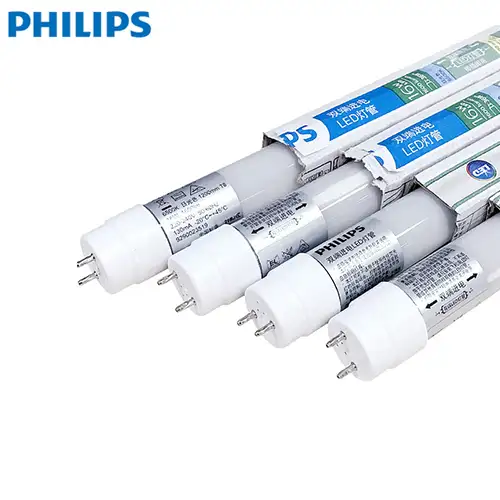
| LED Tube (T8/T5) | 9W–24W | Retrofit into existing fixtures | Quick fluorescent replacement projects | Type A (ballast-compatible) vs Type B (ballast-bypass) |
| LED Ceiling Light | 12W–36W | Surface/flush mount | Residential lobbies, hotel corridors, stairwells | Decorative design matters; dimming compatibility |
| LED Bracket Light | 50W–200W | Wall/bracket mount | Warehouse perimeters, loading docks, stadium concourses | Asymmetric optics for wall washing vs. area illumination |
For PHILIPS-branded indoor solutions, browse the complete range of PHILIPS indoor LED lighting products—from office panels to industrial highbays. For budget-conscious projects that still demand quality, Honnex LED Panel lights offer competitive pricing with full certification compliance.
Outdoor & Area LED Lighting
Outdoor LED lighting must contend with weather, temperature extremes, and—increasingly—light pollution regulations. Here's the breakdown:
| Fixture Type | Typical Wattage | Mounting Height | Best Applications | Key Spec Considerations |
|---|---|---|---|---|
| LED Floodlight | 50W–500W | 5–25m poles or building-mounted | Building facades, sports fields, construction sites, perimeter security | Beam angle (narrow spot to wide flood); IP65 minimum; surge protection 10kV |
| LED Street Light | 30W–300W | 6–15m poles | Roadways, residential streets, industrial parks, campus roads | IESNA Type II/III/IV/V distribution; 3000K–4000K preferred (dark-sky compliant) |
| LED Tunnel Light | 40W–200W | Ceiling/wall in tunnels | Highway tunnels, underpasses, mining tunnels | IP66; anti-glare optics; emergency bypass circuit; corrosion-resistant housing |
| LED Wall Washer | 24W–72W | Ground or bracket-mounted | Building facades, architectural features, signage illumination | Asymmetric optics; RGBW options; DMX/DALI control compatible |
| LED Washer/Linear Flood | 18W–60W | Low-level mounting | Landscape accent, bridge detailing, monument lighting | Narrow beam gradient; 24V DC for safety near water features |
| LED Lawn/Garden Light | 5W–20W | Ground stake | Pathways, gardens, campus landscaping | 12V/24V DC; spike mount; corrosion-resistant (brass/aluminum) |
| LED Underground Light | 5W–30W | In-ground recessed | Driveways, plazas, architectural uplighting | IP67 minimum; load-bearing rating (vehicle traffic); tempered glass lens |
| LED Point/Inground | 3W–12W | Recessed in-ground | Pathway markers, step lighting, deck accent | IP67; anti-glare honeycomb louver; stainless steel faceplate |
For outdoor projects, explore outdoor LED lighting solutions from PHILIPS—the global market leader—matched with Honnex's own industrial LED flood lights for high-performance area illumination at competitive price points.
Specialty & Smart LED Lighting
Beyond general illumination, several specialized LED categories address niche industrial and commercial needs:
- UV-C Disinfection Lighting: UV-C disinfection lighting using PHILIPS TUV technology operates at 254nm to inactivate microorganisms in water treatment, HVAC coil sterilization, surface disinfection in healthcare, and food processing conveyor lines. PHILIPS TUV lamps are the industry benchmark with proven 9,000-hour effective life.
- Infrared (IR) Lighting: Industrial infrared lighting serves industrial heating, drying, curing, and security/surveillance applications. PHILIPS IR lamps cover wavelengths from short-wave (for rapid heating) to medium-wave (for even curing).
- PHILIPS Hue Smart LED: The PHILIPS Hue smart lighting ecosystem brings full-color tunability, circadian rhythm scheduling, occupancy-based automation, and voice/app control to commercial spaces—offices, hospitality, retail, and healthcare. For building managers, the Hue system integrates with major BMS platforms and supports up to 50 lights per bridge.
LED Lighting Type Decision Matrix (Quick Reference)
If you know your space type but aren't sure which fixture to specify, start here:
| Facility Type | Primary Fixture | Secondary Fixture | Smart Control? |
|---|---|---|---|
| Warehouse (high ceiling, >25 ft) | LED Highbay (150–240W, narrow beam) | LED Batten for rack aisles | 0-10V + occupancy sensors |
| Warehouse (low ceiling, <20 ft) | LED Lowbay (80–120W, wide beam) | LED Tri-proof for cold storage zones | DALI for zone control |
| Factory (general assembly) | LED Highbay (150W, 5000K) | LED Tri-proof (IP65) for washdown | 0-10V dimming |
| Factory (precision) | LED Panel (4000K, CRI 90+) | LED Linear for task lighting | DALI-2 for scene recall |
| Open Office | LED Panel (36W, 4000K, UGR<19) | LED Linear suspended | DALI-2 + daylight harvesting |
| Private Office | LED Panel (30W, 3500K–4000K) | LED Downlight accent | Casambi (wireless) |
| Retail Floor | LED Track (CRI 95+, adjustable) | LED Linear (4000K) | Casambi + scene control |
| Retail Back-of-House | LED Batten or Tri-proof | LED Tube retrofit | 0-10V basic |
| Hotel Guest Room | LED Downlight (3000K, CRI 90+) | LED Ceiling + LED Wall Washer | Casambi (per-room control) |
| Hotel Corridor/Lobby | LED Downlight (3000K) | LED Linear accent | DALI-2 |
| Parking Garage | LED Batten (IP54–IP65) | LED Floodlight for perimeter | 0-10V + motion sensors |
| Outdoor Roadway | LED Street Light (IESNA Type III) | LED Floodlight for intersections | DALI-2 or NEMA 7-pin photocell |
| Food Processing | LED Tri-proof (IP65/66, IK08+) | UV-C for sanitation | 0-10V (simplicity for washdown) |
Part 3 — How to Select the Right LED Lighting: A Practical Framework
Specifying commercial lighting isn't guesswork. Follow this five-step framework to eliminate errors before they become expensive mistakes.
Step 1 — Define Your Space and Application
Every lighting project starts with two questions: What happens in this space? and Who uses it?
Be specific. "A warehouse" isn't enough information. A warehouse that stores palletized goods in racks looks very different from a cross-dock logistics hub where workers read shipping labels all day. The first needs 10–20 fc in the rack aisles and 30 fc at the loading dock. The second needs 30–50 fc at every picking station with minimal shadowing.
Download or sketch a floor plan. Mark:
- Ceiling height at every zone
- Column and truss locations (obstructions)
- Workstation positions and tasks performed
- Existing lighting positions (for retrofits)
- Windows and skylights (daylight contribution)
Step 2 — Calculate Required Light Levels (Lux Guide)
The Illuminating Engineering Society (IES) publishes recommended maintained illuminance levels for every commercial and industrial space type. Here are the standards that matter most:
| Space Type | Recommended fc | Recommended lux | Standard |
|---|---|---|---|
| General warehouse storage | 10–20 | 100–200 | IES |
| Warehouse picking/packing | 30–50 | 300–500 | IES |
| Warehouse shipping/receiving | 30 | 300 | IES |
| Manufacturing (general) | 30–50 | 300–500 | IES |
| Manufacturing (precision) | 75–100 | 750–1,000 | IES |
| Open office | 30–50 | 300–500 | IES / ASHRAE |
| Private office | 30–50 | 300–500 | IES |
| Conference room | 30–50 | 300–500 | IES |
| Corridor/hallway | 10–20 | 100–200 | IES |
| General retail | 50–75 | 500–750 | IES |
| Grocery/supermarket | 50–100 | 500–1,000 | IES |
| Restaurant dining | 10–30 | 100–300 | IES |
| Restaurant kitchen | 50–75 | 500–750 | IES |
| Open parking lot | 1–2 | 10–20 | IES RP-20 |
| Covered parking | 5–10 | 50–100 | IES RP-20 |
| Roadway/street | 0.6–1.2 | 6–12 | IES RP-8 |
| Hospital general | 30–50 | 300–500 | IES / FGI |
| Operating room | 100–200 | 1,000–2,000 | IES / FGI |
| Classroom | 30–50 | 300–500 | IES |
| Gymnasium | 30–50 | 300–500 | IES |
Quick lumen estimation formula:
Total lumens needed = (Target lux × Floor area in m²) ÷ (Utilization factor × Maintenance factor)
Where:
- Utilization factor: typically 0.6–0.8 for indoor commercial spaces (accounts for light lost to walls/ceiling)
- Maintenance factor: typically 0.8 (accounts for lumen depreciation and dirt accumulation over time)
Example: A 1,000 m² open office targeting 400 lux:
Total lumens = (400 × 1,000) ÷ (0.7 × 0.8) = 400,000 ÷ 0.56 ≈ 714,000 lumens
If using 36W LED panels producing 4,200 lumens each → 714,000 ÷ 4,200 ≈ 170 panels needed.
Step 3 — Match Fixture Types to Ceiling Height
Mounting height fundamentally determines which fixture type works. Here's the decision logic:
| Ceiling Height | Recommended Fixture Type | Beam Angle Guidance |
|---|---|---|
| 8–12 ft (2.4–3.7m) | LED Panel, Downlight, Batten, Linear | Wide beam: 90°–120° |
| 12–20 ft (3.7–6m) | LED Lowbay, Linear High-output, Tri-proof | Medium beam: 60°–90° |
| 20–30 ft (6–9m) | LED Highbay (100–150W) | Medium beam: 60°–90° |
| 30–45 ft (9–14m) | LED Highbay (150–240W) | Narrow beam: 30°–60° |
| 45+ ft (14m+) | LED Highbay (240W+), specialized stadium/arena optics | Narrow beam: 15°–30°; may require lens stacking for adequate throw |
Rule of thumb: Higher ceilings demand narrower beam angles to get usable light onto the work plane. A 90° beam at 40 feet produces a light pool roughly 80 feet wide at floor level—but lux drops off sharply at the edges.
Step 4 — Evaluate Environmental Conditions
Match your IP rating to the environment, not your budget:
- Clean, climate-controlled office: IP20 is sufficient. Don't overpay.
- Warehouse with some dust: IP54 minimum. Dust ingress into drivers causes early failure.
- Unheated/cold storage warehouse: IP65. Condensation is a real threat, especially during defrost cycles.
- Food processing with daily washdown: IP65 minimum, IP66 recommended. Stainless steel hardware. IK08+ for impact from carts and equipment.
- Outdoor exposed to rain: IP65 minimum. Add surge protection (10kV minimum).
- Underground/immersed: IP67 or IP68 depending on submersion depth and duration.
- Coastal/marine: IP66 + marine-grade aluminum housing + 316 stainless steel fasteners. Salt spray corrodes standard aluminum within 2–3 years.
Step 5 — Consider Controls, Dimming, and Smart Integration
The control protocol you choose determines everything about future flexibility. Here's how the three main options compare for commercial projects:
| Feature | 0-10V | DALI-2 | Casambi (Bluetooth Mesh) |
|---|---|---|---|
| Communication | Analog, one-way | Digital, two-way | Wireless BLE mesh, two-way |
| Wiring | 5-wire (L, N, E, dim+, dim−) | 6-wire (L, N, E, emergency L, DA+, DA−) | Power only—no data wiring |
| Per-fixture addressing | No (zone only) | Yes (64 devices per line) | Yes (250 devices per network) |
| Fault reporting | None | Built-in (lamp, driver, energy data) | App-based alerts |
| Color/tunable white | No | Yes (DT8) | Yes |
| Commissioning | Physical wiring only | Software + technician | Smartphone app |
| Relative cost | Low | Medium–High | Low–Medium |
| Best for | Warehouses, budget projects, simple dimming | Offices, hospitals, museums, large facilities | Retrofits, heritage buildings, hotels, retail |
Decision shortcut: If you need per-fixture control, fault monitoring, or circadian lighting, go DALI-2 for new construction or Casambi for retrofits. If you just need zone-level dimming and want the lowest cost, 0-10V works and is universally compatible.
For spaces where ambient intelligence matters—like executive offices, client-facing lobbies, or high-end retail—consider the PHILIPS Hue smart lighting ecosystem, which layers full-color tunability and automated scheduling on top of any of these base protocols.
Part 4 — LED Lighting ROI: Why the Numbers Make Sense
The upfront cost of LED lighting is higher than legacy alternatives. But the total cost of ownership flips the equation decisively. Here's the math.
Energy Savings: 65–75% vs Traditional Lighting
A direct energy comparison across the most common commercial fixture replacements:
| Application | Old Technology | Old System Wattage | LED Replacement | LED System Wattage | Annual Savings |
|---|---|---|---|---|---|
| Warehouse highbay | 400W Metal Halide | 458W (incl. ballast) | 150W LED Highbay | 150W | $148/fixture/year |
| Office troffer | 2×32W T8 Fluorescent | 72W (incl. ballast) | 36W LED Panel | 36W | $17/fixture/year |
| Parking garage | 175W Mercury Vapor | 205W (incl. ballast) | 60W LED Batten | 60W | $70/fixture/year |
| Street light | 250W HPS | 295W (incl. ballast) | 100W LED Street Light | 100W | $94/fixture/year |
| Retail track | 50W Halogen MR16 | 50W | 12W LED Track | 12W | $18/fixture/year |
Mini-Story #2 — The 50,000 sqft Warehouse That Paid for Itself in 14 MonthsA logistics distribution center in the Midwest US was running 120 × 400W metal halide highbays—system draw of ~55 kW—for 5,600 hours annually across two shifts. Their total annual lighting electricity cost: approximately $37,000. After installing 120 × 150W LED highbays (system draw: 18 kW), annual lighting electricity dropped to $12,100. That's a 67% reduction, saving roughly $25,000 per year on energy alone. Add $5,000/year in avoided maintenance (no more $85/service-call bulb replacements every 15,000 hours), subtract a one-time $12,000 utility rebate, and the $65,000 project delivered a 14-month payback. From year two onward, the facility pockets a net $30,000 annually.
For facilities considering a similar upgrade, PHILIPS LED Highbay fixtures deliver the efficacy and reliability that makes these numbers work in practice—not just on paper.
Maintenance Reduction and Total Cost of Ownership
The hidden cost of legacy lighting isn't the electricity—it's the maintenance:
| Factor | Metal Halide / HPS | Fluorescent (T8/T5) | Industrial LED |
|---|---|---|---|
| Rated life (L70) | 10,000–15,000 hours | 20,000–30,000 hours | 50,000–100,000 hours |
| Replacement cycles over 10 years (at 4,000 hrs/yr) | 2–4 times | 1–2 times | 0 (still above L70 at 40,000 hrs) |
| Lamp cost per replacement | $15–$50 | $3–$8 | N/A (integral) |
| Labor cost per replacement (lift/equipment) | $50–$150 | $30–$100 | N/A |
| Ballast/driver replacement | Every 2–3 cycles ($30–$80) | Every 2–3 cycles ($20–$50) | Not typically required within rated life |
| 10-year TCO (single fixture, incl. energy + maintenance) | $1,200–$1,800 | $400–$600 | $200–$350 |
Bottom line: Over a 10-year horizon, an industrial LED fixture costs 60–80% less to own than its metal halide equivalent, even though the initial purchase price is higher.
Incentives, Rebates, and Tax Benefits
Commercial LED lighting projects qualify for three overlapping incentive categories:
1. Utility Rebates (DLC)
The DesignLights Consortium (DLC) maintains a Qualified Products List (QPL) covering 80+ categories of commercial LED products. DLC-listed products automatically qualify for prescriptive rebates from most North American utilities. Typical rebate levels: $0.05–$0.15/kWh saved annually, or $10–$75 per fixture depending on wattage reduction.
Always check the DLC QPL before finalizing a spec—DLC Premium-listed products often qualify for higher rebate tiers.
2. Section 179D Tax Deduction (U.S.)
The Energy Efficient Commercial Buildings Deduction (IRC §179D) allows building owners to deduct up to $5.81/sq ft (2025 tax year, with prevailing wage requirements) for lighting systems that reduce energy consumption by 25% or more versus ASHRAE 90.1 baseline. For a 100,000 sq ft facility, that's a potential $581,000 deduction.
Critical deadline: Projects must begin construction before June 30, 2026 to qualify under current law (per the One Big Beautiful Bill Act, Public Law 119-21).
3. Local and State Programs
Many jurisdictions offer additional incentives. Examples include:
- On-bill financing (repay through utility bill savings)
- Property Assessed Clean Energy (PACE) financing
- State-specific tax credits for energy-efficient construction
Stacking strategy: Utility rebate (reduces project cost) + 179D deduction (reduces tax liability) + accelerated depreciation (MACRS 5-year for qualified lighting) can offset 40–60% of total project cost in favorable jurisdictions.
Part 5 — How to Source LED Lighting: From Selection to Supplier
Choosing the right supplier is as consequential as choosing the right fixture. Here's what procurement teams need to know.
Brand-Authorized Distribution vs Direct Factory vs Mixed Model
There are three sourcing models for commercial LED lighting, each with distinct trade-offs:
| Model | Pros | Cons | Best For |
|---|---|---|---|
| Brand-Authorized Distribution | Guaranteed authenticity; full warranty; technical support; spec-grade consistency | Higher unit prices; limited customization; lead times set by brand | Critical installations, premium projects, spec-driven public tenders |
| Direct Factory / OEM | Lower unit prices; full customization; flexible MOQs; direct quality dialogue | Quality variance risk; requires in-house QC expertise; warranty enforcement can be challenging | High-volume orders, custom fixtures, cost-sensitive projects |
| Mixed Model (Hybrid) | Best of both: brand-grade critical components + OEM savings on bulk items; single point of contact | Requires a supplier with genuine multi-brand authorization and OEM capability | Most commercial and industrial projects |
The mixed model is increasingly the preferred approach for mid-to-large commercial projects. It works like this: specify PHILIPS for spec-grade installations (client-facing areas, critical task lighting, areas where warranty and long-term parts availability matter) and leverage OEM production for high-volume utility fixtures (warehouse highbays, parking garage battens, outdoor floodlights) where the cost difference is most material.
Honnex operates this exact model—as a PHILIPS China-authorized distributor with 15 years of LED lighting industry experience and its own manufacturing capability for Honnex-branded products. This means clients get verified PHILIPS authenticity with full warranty for premium applications, plus factory-direct pricing on Honnex LED lighting products where OEM makes commercial sense.
Key Certifications to Look For
When evaluating any LED supplier—branded or OEM—verify these certifications:
| Certification | Region | What It Covers | Why It Matters |
|---|---|---|---|
| CE | European Union | Safety, EMC, RoHS compliance | Minimum legal requirement for EU market access |
| UL / ETL | North America | Electrical safety (UL 1598 for luminaires) | Required by code in most U.S. jurisdictions |
| DLC | North America | Performance qualification for commercial LED | Required for utility rebate eligibility |
| SAA | Australia / NZ | Electrical safety approval | Required for legal sale in Australia |
| ENEC | Europe | Comprehensive safety + performance | Premium European certification beyond basic CE |
| ISO 9001 | Global | Quality management system | Indicates consistent manufacturing processes |
| ISO 14001 | Global | Environmental management | Required by many corporate ESG procurement policies |
| IEC 62471 | Global | Photobiological safety (blue light hazard) | Ensures LED products don't pose retinal risk |
Red flags in supplier evaluation: missing test reports for claimed certifications, reluctance to share factory audit results, batch-to-batch color temperature variance exceeding ±150K, and lead times that seem "too good to be true" (often indicate stock quality issues).
OEM & Customization: When Standard Products Don't Fit
Standard catalog products cover roughly 80% of commercial lighting needs. The remaining 20% require customization. Common OEM customization scenarios include:
- Custom CCT: Standard products typically offer 3000K/4000K/5000K. If you need 3500K across an entire hotel chain for brand consistency, that's an OEM order.
- Custom housing finish: Matching architectural metal finishes (RAL colors, wood-grain, brushed metallic) for high-visibility applications.
- Custom optics: Beam angles not available in standard product lines, or asymmetric distributions for specific mounting constraints.
- Integrated sensors: Embedding occupancy/daylight sensors directly into the fixture housing rather than external add-ons.
- Custom driver programming: Specific dimming curves, CLO (Constant Light Output) profiles, or emergency battery integration.
For any OEM project, the minimum order quantity (MOQ) is typically 500–2,000 units depending on customization complexity. The lead time stretches to 6–12 weeks versus 2–4 weeks for standard products. For projects requiring specialized components, OEM LED drivers and modules from PHILIPS provide a reliable foundation to build custom fixtures around.
Quality Control Checklist for LED Lighting Buyers
Before signing any purchase order, verify these twelve items:
- LM-80 test reports for the LED chips: confirms lumen maintenance data (L70, L90) at tested temperatures
- TM-21 projections derived from LM-80 data: calculated lifetime projections for your fixture's expected operating temperature
- ISTMT (In-Situ Temperature Measurement Test): verifies actual LED junction temperature inside the fixture (should be ≤85°C for most designs)
- Integrating sphere test reports: confirms actual lumen output, CCT, and CRI match the spec sheet
- Flicker metrics: IEEE 1789 flicker percentage (<8% for office environments) and SVM/Pst LM values
- Surge protection test: 4kV minimum for indoor commercial, 10kV for outdoor applications
- Driver reliability: MTBF rating (typically ≥50,000 hours at Tc max) and capacitor brand/rating (Japanese capacitors preferred: Rubycon, Nichicon, Nippon Chemi-Con)
- Thermal imaging of the fixture at steady state: identifies hot spots that could indicate design flaws
- Ingress protection test certificate: not just a claimed IP rating, but actual test results from an accredited lab
- Salt spray test (if coastal): 1,000+ hours rating for marine environments
- Pre-shipment inspection (PSI) report: AQL 2.5 or tighter for critical defects
- Warranty terms in writing: 5 years is standard for commercial LED; 7–10 years for premium products. Verify what's actually covered (driver? LEDs? housing? labor? shipping?)
Mini-Story #3 — The Food Plant That Learned About IP Ratings the Hard WayA poultry processing facility in Texas specified "waterproof LED fixtures" for their daily high-pressure washdown zones. The supplier delivered IP54-rated battens—dust-protected, splash-resistant, but absolutely not rated for jet washing. Within six months, moisture ingress corroded the drivers. Flickering started. Then outages. The facility manager spent $28,000 on emergency replacements plus $15,000 in overtime labor for the swap-out—roughly triple what specifying IP65 tri-proof fixtures up front would have cost. The replacement order? IP65 tri-proof LED fixtures with stainless steel clips and silicone gaskets, rated for exactly this environment. Two years later: zero failures.
Part 6 — Industry Applications & Case Insights
Different industries present different lighting challenges. Here's what matters in each.
Warehouse & Logistics
Key requirements: High uniformity, minimal glare (forklift operators need clear sightlines), robust construction, and—increasingly—wireless controls for adaptive zoning.
Typical spec:
- 150W–200W LED Highbay, 5000K, CRI 80+, 90° medium beam
- 30 fc at picking stations, 20 fc in storage aisles, 30 fc at loading docks
- 0-10V dimming with occupancy/daylight sensors for aisle-by-aisle control
- IP54 minimum, IP65 for unheated/dusty warehouses
For facilities running two or three shifts, the ROI on occupancy-based dimming in low-traffic aisles can reduce energy use by an additional 40–60% beyond the LED conversion itself. PHILIPS LED Highbay fixtures with integrated sensor compatibility make this a straightforward implementation.
Manufacturing & Factory Floor
Key requirements: High CRI for quality inspection, appropriate CCT for task type, rugged construction for vibration/humidity/dust, and—in food/pharma—hygienic design.
Typical spec by zone:
| Zone | Fixture | CCT | CRI | IP Rating | Notes |
|---|---|---|---|---|---|
| General assembly | LED Highbay 150W | 5000K | 80+ | IP54 | Wide distribution |
| Precision assembly / QC | LED Panel 36–48W + task lighting | 5000K–6500K | 90+ | IP20 (clean room) | Supplementary task lighting at 750–1,000 lux |
| Washdown / food processing | LED Tri-proof 40–60W | 4000K–5000K | 80+ | IP65/66 | Stainless steel clips, silicone gaskets |
| Paint booth / hazardous | Explosion-proof LED | 5000K | 80+ | Class I Div 2 minimum | ATEX/IECEx certified |
| Raw material storage | LED Batten 40W | 5000K | 80+ | IP54 | Basic utility lighting |
Office & Commercial Buildings
Key requirements: Visual comfort (UGR <19), flicker-free drivers, tunable white for circadian support, and integration with building management systems.
PHILIPS LED Panel lights for commercial spaces are the workhorse of modern office lighting: 36W standard, 4000K for general areas, UGR <19 with micro-prismatic diffusers, and DALI-2 compatibility for daylight harvesting and presence detection.
Real-world result: A 15-story office building in Singapore replaced 2,800 fluorescent troffers (2×32W each, 72W system draw per fixture) with 36W LED panels across all floors. Lighting energy consumption dropped from 812,000 kWh/year to 406,000 kWh/year—a 50% reduction. Illuminance at desk level actually increased from 280 lux to 380 lux because LED panels direct more light downward with less loss into the ceiling plenum. Annual electricity savings: approximately $48,700 at local commercial rates.
Retail & Hospitality
Key requirements: High CRI (90+), precise beam control for accent lighting, warm CCT for hospitality (2700K–3000K), and scene-based control for different times of day.
For retail environments, PHILIPS LED spot lights with CRI 95+ and adjustable beam angles (15°/24°/36°) are the go-to for merchandise highlighting. In hospitality, commercial LED downlights at 2700K–3000K with deep recessed baffles minimize glare in guest-facing spaces.
The control layer matters enormously here. Casambi-based wireless systems let store managers reconfigure lighting zones seasonally without rewiring—a capability that pays for itself the first time a floor layout changes.
Outdoor & Infrastructure
Key requirements: Weather resistance, surge protection, light pollution compliance, and long service intervals (changing a streetlight bulb costs $150+ in labor and equipment).
For roadway and street applications, LED street lighting from PHILIPS uses IESNA Type II, III, or IV distributions to put light precisely where needed—on the road surface—while minimizing spill onto adjacent properties. For area and perimeter security, outdoor LED floodlight solutions with 10kV surge protection and narrow-to-wide beam options cover everything from loading dock illumination to sports field lighting.
Conclusion
The commercial and industrial LED lighting landscape in 2026 is both more capable and more complex than at any point in the past decade. The core truths are simple: LED technology now delivers 150–200 lm/W, cuts energy consumption by 65–75% versus legacy systems, and offers 50,000+ hours of useful life. The complexity lies in matching the right fixture, the right specification, and the right supplier to your specific project.
Here's a recap of the five decisions that determine project success:
- Spec by lumens, not watts—and verify CRI, CCT, and IP rating against the actual tasks performed in each space
- Follow the IES lux recommendations for your space type, and use the simple lumen formula to avoid over- or under-lighting
- Choose your control protocol based on future flexibility needs, not just today's budget—DALI-2 for new construction, Casambi for retrofits, 0-10V for straightforward dimming
- Stack incentives aggressively: utility rebates (DLC-listed products), Section 179D tax deductions (act before June 2026), and accelerated depreciation can offset 40–60% of project cost
- Adopt a hybrid sourcing model: brand-authorized distribution (like PHILIPS) for critical applications, plus OEM for high-volume standard fixtures—getting the cost-benefit balance right
The 60% of commercial buildings still operating on fluorescent and HID systems represent both a staggering waste of energy and an enormous opportunity. Every month of delay costs real money—in electricity, in maintenance labor, and in missed productivity from subpar lighting quality.
Ready to put this guide into practice? Whether you're planning a single-facility retrofit or a multi-site rollout, start with a free lighting project consultation. Our team can help you build a fixture schedule, calculate ROI with your local utility rates, and connect you with PHILIPS and Honnex products that match your technical requirements and budget.
Frequently Asked Questions
1. What's the difference between commercial and industrial LED lighting?
Commercial LED lighting is designed for offices, retail, hospitality, and similar occupied spaces where visual comfort (low glare, appropriate CCT, high CRI) is the priority. Industrial LED lighting is built for warehouses, factories, and processing facilities where durability (high IP rating, impact resistance, wide temperature tolerance) and raw light output matter more than aesthetics. That said, the line is blurring: modern industrial LEDs now offer commercial-grade light quality, and commercial fixtures increasingly borrow industrial durability features.
2. How much can I actually save by switching to LED lighting in a commercial building?
Energy savings typically range from 50–75% depending on what you're replacing. A fluorescent-to-LED office retrofit usually saves 45–55% on lighting electricity. A metal-halide-to-LED warehouse conversion saves 65–75%. Add maintenance savings (no bulb changes, no ballast replacements), and total cost of ownership over 10 years is typically 60–80% lower than legacy systems—even accounting for the higher upfront LED cost.
3. What IP rating do I need for outdoor LED floodlights?
IP65 is the minimum for outdoor LED floodlights exposed to rain. It provides complete dust protection and resistance to water jets from any direction. For coastal installations, step up to IP66 and specify marine-grade aluminum housing with 316 stainless steel hardware. For in-ground uplighting (driveway markers, plaza lights), IP67 or IP68 is required.
4. How long do commercial LED lights actually last?
Most quality commercial LED fixtures carry an L70 rating of 50,000 hours—meaning the LED light output will still be at 70% of its original brightness at that point. At 12 hours/day, 365 days/year operation, that's roughly 11.4 years. Premium fixtures achieve L70 ratings of 100,000 hours. Note that the LED driver (power supply) often determines actual service life: a fixture with a 100,000-hour LED module paired with a 50,000-hour driver will likely need driver replacement at the 50,000-hour mark.
5. Should I buy PHILIPS-branded LED fixtures or generic/OEM alternatives?
It depends on the application. For client-facing spaces, spec-grade projects with warranty requirements, and critical task lighting where color consistency and long-term parts availability matter—go with PHILIPS. For high-volume utility applications (warehouse aisles, parking garages, basic outdoor area lighting), a quality OEM product from a reputable manufacturer can deliver 90% of the performance at 50–60% of the cost. The optimal approach is a hybrid strategy: brand-authorized for critical zones, OEM for volume applications, all from a single supplier who can manage both.
6. What are the most common mistakes in commercial LED lighting projects?
The five most expensive mistakes we see: (1) specifying by wattage instead of actual delivered lumens, leading to over-lit or under-lit spaces; (2) ignoring CRI—CRI 70 fixtures in spaces where color accuracy matters (retail, QC, medical) directly impact revenue and safety; (3) choosing the wrong CCT—5000K in offices causes eye strain and fatigue over 8-hour shifts; (4) under-specifying IP ratings—IP54 in washdown environments guarantees early failure; and (5) not factoring in control wiring during construction—adding DALI or Casambi after drywall is up costs 3–5× more than running the cable during rough-in.
This guide was last updated June 2026. Market data sourced from GM Insights, MarketsandMarkets, and the U.S. Department of Energy. IES illuminance recommendations per ANSI/IES RP standards. Tax incentive information per IRS §179D and the U.S. Department of Energy. Always verify current incentive programs with your local utility and tax professional.
Related News